Labral Tear
What is Shoulder Arthritis?
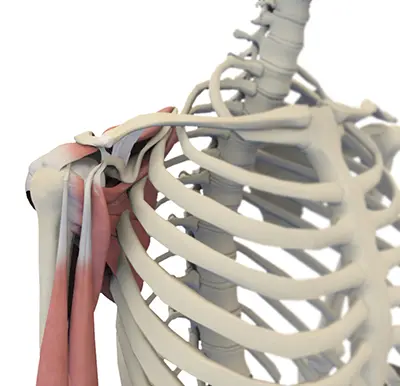
Cartilage damage or inflammation of the shoulder joint can gradually lead to arthritis. Cartilage is a smooth tissue found inside joints that cushions the bones and allows them to glide easily across one another. As cartilage wears down, patients begin to experience pain and stiffness in their shoulder. When the cartilage completely deteriorates, the bones rub directly against each other, causing significant pain and inflammation.
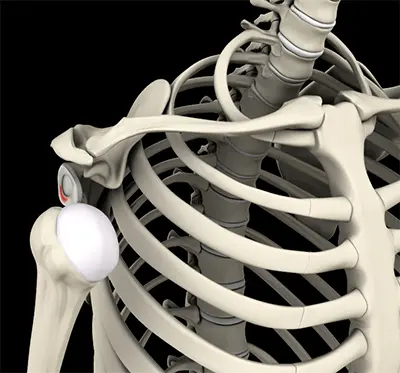
There are two joints in the shoulder that can be affected by arthritis. The main shoulder joint, the glenohumeral joint, is the ball-and-socket joint formed by the humeral head (the “ball” of the upper arm bone) and the glenoid (the “socket” on the shoulder blade). The acromioclavicular (AC) joint, located where the acromion (top of the shoulder blade) meets the clavicle (collarbone), can also develop arthritis.
Causes
Several factors can lead to shoulder arthritis, including:
- Osteoarthritis: The most common cause, resulting from wear and tear of the joint over time.
- Rheumatoid arthritis: An autoimmune disorder in which the immune system attacks the lining of the shoulder joint.
- Post-traumatic arthritis: Develops after an injury such as a fracture or dislocation.
- Rotator cuff tear arthropathy: Occurs after a large or long-standing rotator cuff tear, causing abnormal joint motion and cartilage wear.
- Avascular necrosis: Loss of blood supply to the shoulder bones can cause bone death and secondary arthritis.
Symptoms
Common symptoms of shoulder arthritis include joint pain, stiffness, reduced range of motion, and sensations of grinding, clicking, or cracking within the joint.
Diagnosis
Diagnosis typically involves a combination of medical history, physical examination, and imaging tests.
- X-rays can reveal bone changes, joint space narrowing, and bone spurs.
- Physical examination helps assess range of motion, pain, and stability.
- Medical history review helps identify risk factors, prior injuries, or surgeries contributing to the condition.
Treatment Options
While damaged cartilage cannot regrow, non-surgical treatments can help relieve symptoms. Options may include:
- Activity modification and rest
- Ice and heat therapy
- Nonsteroidal anti-inflammatory drugs (NSAIDs)
- Cortisone injections
- Platelet-rich plasma (PRP) injections
Surgical Options
If non-surgical treatments fail to provide relief, surgical interventions may be considered:
- Shoulder arthroscopy: A minimally invasive procedure to remove bone spurs or loose fragments.
- Total shoulder replacement: An open surgical procedure that replaces the damaged glenohumeral joint with implants customized to each patient.